
Rugs get inherited with a house, shipped home at the end of a posting, carried down from a bigger place during a downsize, or bought because they went with the sofa — and then nobody knows what they are standing on. It matters, because the most expensive mistake in rug ownership is treating an heirloom like a doormat, and the second most expensive is paying heirloom money to clean a doormat. This is enough to tell them apart.
How a Rug Is Actually Made
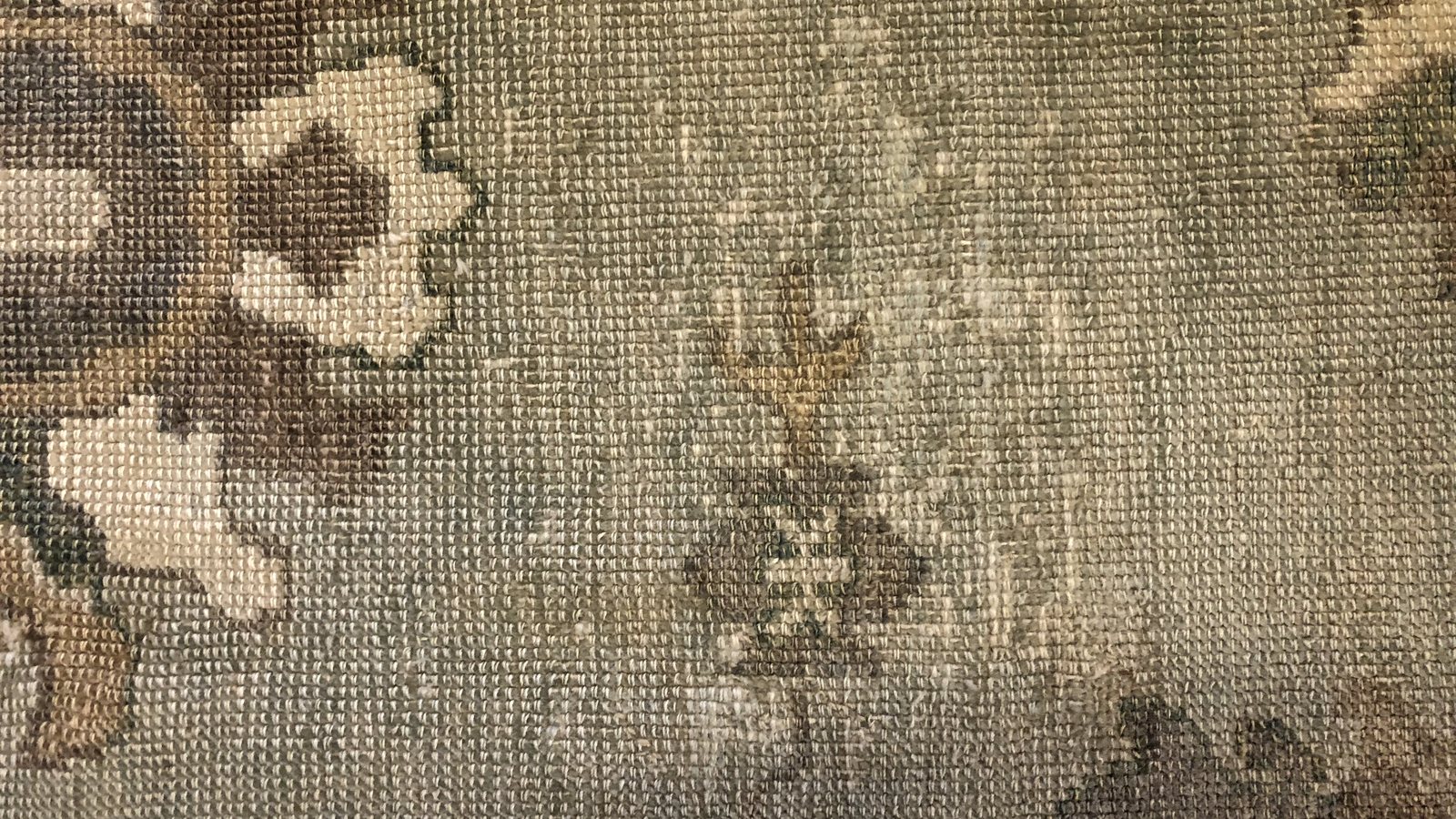
Underneath any pile rug there is a grid holding the whole thing together. Warps run the length of it and carry the tension — the fringe is not sewn on, it is simply where those warps run out of rug. Wefts cross them and pin each finished row down. Everything you can see is attached to that grid, and the manner of attachment is what separates a rug worth restoring from a rug worth replacing.
On a hand-knotted rug the pile goes in one knot at a time: a short loop of wool or silk wrapped round a pair of warps, beaten down, locked under the next weft, repeated. Count them across an ordinary nine-by-twelve and you are into the millions. That is the whole explanation for the price, and equally the explanation for why these things routinely outlive the people who bought them.
Knot types
- Persian (asymmetric) knot — takes a full turn round one warp and slips loosely behind its partner. That looseness is what lets a weaver draw a curve rather than a staircase, which is why it dominates Persian, Indian and Chinese work.
- Turkish (symmetric) knot — wraps both warps evenly. Tougher and a little more geometric in what it can render, and standard in Turkish and Caucasian weaving.
- Tibetan loop knot — wool looped continuously over a rod and then cut. Modern, quick, and the reason contemporary Nepalese rugs have that thick, unusually even pile.
Telling Hand-Knotted from the Rest in Ten Seconds
Turn the rug over. That is the entire trick, and it settles the question faster than any label sewn onto the back.
| Construction | The back looks like | What it means |
|---|---|---|
| Hand-knotted | The pattern reads through to the back in slightly irregular knots. The fringe is continuous with the foundation. | Decades to centuries of life. Fully cleanable, fully repairable, holds value. |
| Hand-tufted | A canvas or scrim backing glued across the whole underside, hiding everything. Fringe sewn on as a separate strip. | Ten to twenty years. The latex adhesive eventually fails and starts to smell. Cleanable with care. |
| Machine-made | A perfectly uniform grid, usually on a stiff synthetic backing. The flawless regularity is the giveaway. | Five to fifteen years. Very cleanable, essentially unrepairable, cheap to replace. |
| Flatweave (kilim, dhurrie) | No pile at all. The same pattern both sides, fully reversible. | Light and durable. Needs tight moisture control during cleaning. |
Quick field test: fold the rug back on itself and look down into the base of the pile. Knots tied round visible warps mean hand-knotted. A wall of dried glue means tufted.
Fibres, and What Each One Wants
Wool
The default, and deservedly. Wool fibres are naturally crimped, so they recover under furniture; they carry lanolin, which sheds soil until somebody strips it out with harsh detergent; and they are difficult to ignite. Wool will also hold close to a third of its own weight in water without feeling damp to the hand — excellent for comfort, and a real liability in a valley that spends months at a high dew point. That single property sits behind most of the musty-rug calls we take.
Silk
Fine, immensely strong in tension, unmatched for detail and sheen. Also unforgiving: it scorches under heat, weakens while it stays wet, and browns wherever a spill is left to sit. Silk belongs away from direct traffic and direct sun, and it never goes into a full-immersion wash.
Viscose, bamboo silk, art silk
Three names for regenerated cellulose. It looks like silk on a showroom floor and behaves like wet paper in a house. Viscose loses most of its strength when it is saturated, yellows from plain water, and mats permanently underfoot. If you own one, keep it out of dining rooms and entry halls, keep it well away from a sunroom door, and never let anyone wet-clean it conventionally.
Cotton
Usually the foundation rather than the pile, and in a flatweave it is the entire rug. Cotton absorbs heavily, shrinks if it is dried under tension, and is the first part of a rug to rot after a soaking — which is why a rug that has spent years on a damp slab fails at the foundation while the wool above it still looks fine.
Jute, sisal and seagrass
Beautiful texture, dreadful relationship with water. These plant fibres stain from their own moisture, brown along the edges, and mildew faster than anything else in the room. A screened porch or a glazed-in sleeping porch in this valley is close to the worst place you could put one.
Synthetics
Polypropylene, nylon and polyester. Inexpensive, fade-resistant and genuinely sensible for a mudroom, a rental or a family room that opens onto a yard. They crush under furniture and cannot be repaired, but they clean well and cost little to replace, which is the entire point of them.
CSRA Care Notes
Most rug advice online assumes one climate and one kind of dirt. This corner of Georgia and South Carolina supplies neither. Two hundred feet of elevation separate the river plain from the top of the Hill, the soil changes completely over that distance, and across the river there is horse country that sends a third material through the door entirely. Adjust accordingly.
Know which soil you have
Down on the floodplain it is alluvial silt — particles fine enough to hang in the air behind a passing car and small enough that a domestic vacuum pulls air straight over the top of them. Silt does not make a mark; it greys the whole rug evenly, which is why owners read it as the rug “going dull” and buy brighter lamps instead of calling anyone. Up on the ridge it is sand, which is coarse and angular and does the opposite: it sinks to the base of the pile, lodges against the knots, and gets worked against the fibre like sandpaper by every footstep. One is a colour problem you cannot see and the other is a wear problem you cannot feel.
Barn soil is its own category
If there is a horse on the property, the rug is dealing with something no ordinary house produces. Arena footing is specified angular rather than rounded so that hooves can grip, which means the sand arriving in a boot tread is deliberately sharp. Stall residue is ammoniacal and alkaline, and alkalinity is what lifts natural dye off wool. Hoof dressing, fly spray and leather conditioner are oily, and an oily film is what converts loose sand into a bound, dark deposit that will not vacuum out at all. A barn-boot mat at every door earns its keep faster here than anywhere else on the route.
Look underneath the rug, not just at it
Most of the serious damage in this market is on the reverse. A slab poured before vapour barriers were standard practice moves ground moisture upward continuously, and a solid rubber or vinyl pad on top of it turns the rug into a lid — wet from below, sealed from above, permanently. Use a breathable, non-adhesive pad, and lift each rug two or three times a year so that both the floor and the back of the rug get a chance to dry. If the underside smells and the pile does not, you have found it.
Beware the pad you bought to stop it slipping
New vinyl plank is slick, so a grip pad goes down — and the cheap ones are PVC or a foam scrim loaded with plasticiser to make them cling. Those additives migrate. They print a yellow-brown waffle pattern onto the floor, and the same compounds wick upward into the cotton foundation of the rug as an oily stain that ordinary cleaning chemistry will not touch. After a few warm summers the pads embrittle as well and shed a gritty crumb into the backing. Felt-and-natural-rubber pads cost more once and avoid all of it.
Watch the enclosed porch in winter
A sleeping porch glazed in decades ago is a room made of single-pane glass sitting outside the thermostat’s real reach. On a cold clear night it drops to near outdoor temperature while warm humid air keeps leaking in from the house, and by morning that moisture is running down the panes onto the sill and then onto the floor — along the perimeter, which is exactly where the rug edge lies. Move the rug in from the glass line, or accept that one or two of its sides will rot at the selvedge while the middle stays perfect.
Cold is not the same as dry
An air conditioner only removes water from the air while it is actually running. A system that is larger than the house needs reaches its setpoint quickly and shuts down, so it short-cycles all summer and dehumidifies very little — producing a house that feels cold and reads high on a hygrometer at the same time. Wool notices even when people do not. A cheap hygrometer in the room with the good rug is the most useful twelve dollars a rug owner in a new house can spend.
Keep the robot off the rug
A robot vacuum has almost no airflow at depth, so it lifts surface lint and leaves the sand at the base of the pile exactly where it was, while convincing the household that the rug is being cleaned daily. Worse, it navigates by repeating routes and treats fringe as string — catching the warp ends in the brush roll and dragging them out of the foundation a few at a time. Set a keep-out zone around the good rugs, and vacuum those by hand with the beater bar switched off.
Storage and shipping ruin more rugs than traffic
A rug rolled into a garage or an unconditioned unit for a season is being handed to moths and mildew simultaneously. Larvae feed on the soil and body oil in the wool rather than on clean fibre, so a dirty rug going into storage is bait and a clean one largely is not. Shipping is the same problem with a longer clock: a steel container crossing an ocean goes through a condensation cycle every night for weeks, and a rug wrapped in plastic for the journey is worse off, not better, because the plastic decides where the water collects. Clean before storing rather than after, roll pile-out, keep it off the floor, and unroll a rug the week it arrives rather than the month it gets unpacked.
Blot spills immediately, and skip the miracle cleaner
Press a white towel straight down and lift — never rub, which drives the spill into the foundation and fuzzes the pile. Cool water handles most fresh spills. Over-the-counter spot removers are typically high-pH and will strip dye out of wool, converting a small problem into a permanent one.
Act fast on water
A wet rug in a warm room has roughly forty-eight hours before mould takes hold in the foundation. Get it up off the floor, do not seal it in plastic, photograph it before you move it, and get it to a specialist rather than pointing a fan at it — a fan dries the surface and locks the contamination into the base of the pile. Rugs their owners were ready to throw out are recoverable far more often than people expect. Here is what that restoration involves.
How Often Should It Be Cleaned?
| Where the rug lives | Professional cleaning |
|---|---|
| Entry, hallway, main living room | Every 12 months |
| Dining room or kitchen-adjacent | Every 12–18 months |
| Bedrooms and low-traffic rooms | Every 2–3 years |
| Homes with pets or allergy sufferers | Every 6–12 months |
| Houses with a barn or paddock on the property | Every 6–12 months, and check the back each time |
| The single runner everyone walks in on from the garage | Every 6–12 months |
| Any rug on a pre-1960 slab | Every 12 months, and lift it twice a year regardless |
| Any rug that has been wet | Immediately |
Is It Worth Anything?
Value in a hand-knotted rug comes out of knot density, the quality of the wool, whether the dyes are natural or synthetic, age, origin, condition, and whether the design is any good. A finely woven antique in sound condition can be worth many times what a large, coarse modern rug costs, even though the modern one covers more floor.
Two things people consistently get wrong. First, condition matters enormously — unravelling ends, moth grazing and a badly cut edge knock value down fast, and all three are repairable, which is exactly why fixing them tends to pay for itself. Second, wear is not automatically bad: an old rug with even, honest low pile and intact structure is worth considerably more than one with pristine corners and a hole in the middle.
If you are curious about something that came with the house, came home in a container, or came down from a larger place, send photographs of the front, the back and the ends. We will tell you what it is, roughly where it came from, and whether it is worth restoring — at no charge and with no pressure attached.
Short Glossary
- Warp — the lengthwise foundation threads; the fringe is their exposed ends.
- Weft — the crosswise threads that lock each row of knots down.
- Pile — the surface you walk on, made of the cut ends of the knots.
- KPSI — knots per square inch; higher means finer detail and far more work.
- Abrash — natural colour banding from different dye lots. A feature of hand-dyed wool, not a fault.
- Selvedge — the wrapped side edges that stop the rug unravelling sideways.
- Filtration soiling — the dark, crisp-edged line that appears where air is drawn past the edge of a rug, carrying fine soot with it.
- Dry rot — foundation fibres weakened by prolonged damp; the reason wet rugs are urgent.
- Blocking — stretching a washed rug back to square while it dries.